Designing and constructing different kinds of structures is challenging work. Depending on the architect’s vision, you might need specially made fittings and designs to be included in the process. Some architectural design projects are so radical that determining suitable materials to use can already be quite the challenge. Not every metal fabrication company can create custom architectural structures that are unique to the customers. For such concerns, VeriForm can be of service. When dealing with an architectural design that needs custom accents or shapes, a metal fabrication company with custom architectural fabrication capabilities will be your best friend.
What is Custom Architectural Fabrication
To start, custom architectural fabrication is when unique metal statues, shapes, sculptures, or accents are created for specific architectural designs. Different industries such as construction require metal projects that differ in design based on the project or customer’s needs. Custom architectural fabrication is meant to create exclusive formations that stand out or may not be something that can be commonly found.
The Custom Architectural Fabrication Process
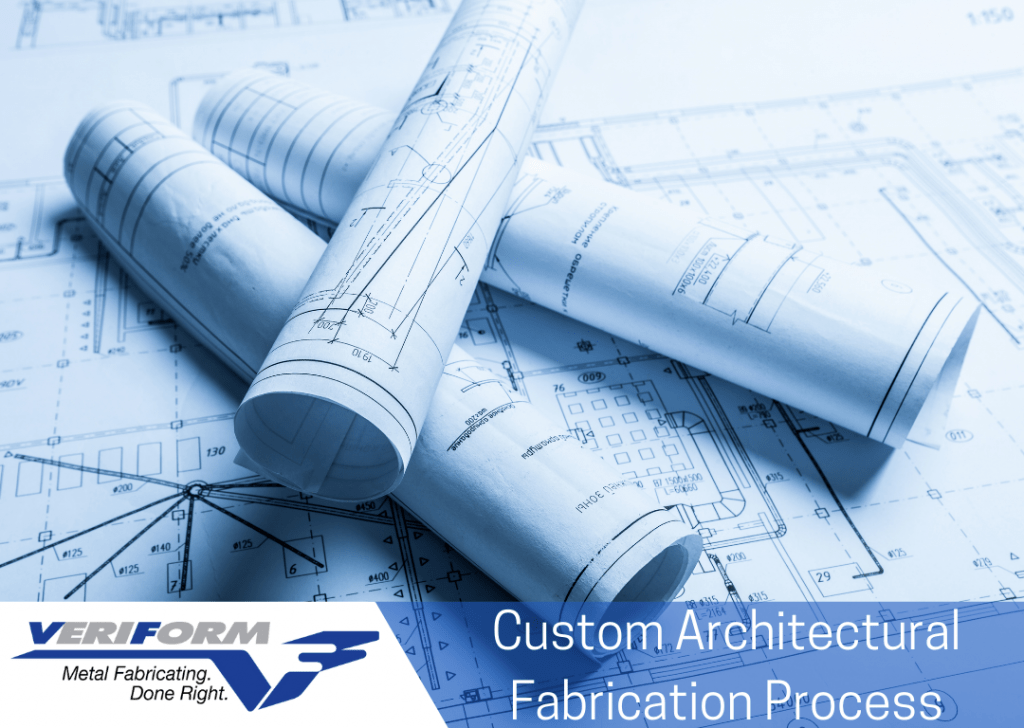
To make the proper custom metal structure, a metal fabrication company must follow a thoroughly detailed process. The process ensures that the output is precisely what the designer envisioned it to be. Because it’s a custom design, there are no existing molds to use, so it begins at the drawing table. Here’s a quick rundown of the process.
1. Consultation & Estimation:
The first step involves a consultation with specialists from the metal fabrication company and the designer and/or customer. They will then, discuss the project in explicit detail to ensure that the specialist gets a good idea of the designer’s vision. Once the specialists understand what the designer wants, they will then estimate the budget and timeline. If everything is agreeable to both parties, they can move on to the next step.
2. Transforming Idea to Design:
Drawings of the metal project are then generated using design software such as CAD and SolidWorks. This allows computers to understand the design. It allows the design to be used for further processing. This means that the final CAD drawing needs to be exact and approved by both the design team and the specialists.
3. Fabrication:
The next step is taking the CAD drawing, creating the molds if necessary and fabricating the physical structure. The fabrication process includes the following phases:
Laser Cutting – For custom architectural projects, sheet metal must be unrolled, measured, and cut from a larger roll.
Forming – The cut metal is then bent and formed into different shapes and forms.
Joining – The formed metal pieces are then assembled and welded to form the architectural design.
Finishing – Once the ideal shape/design is achieved, the whole project will be given the finishing touches to enhance it.
4. Delivery:
Once a custom metal project is finished, it is either delivered to a designated location or picked up by the designer and team. Depending on the structure and the metal fabrication company, occasional follow-ups and maintenance may be scheduled for the custom architectural fabrication project.
Custom Architectural Design Fabrication
Regardless of the project, finding a good metal fabrication company to help you with your custom architectural fabrication project can be challenging. However, if you need a trusty metal fabrication company in Ontario, Canada, you can contact VeriForm at any time for your custom architectural design needs. VeriForm has over 23 years of experience in transforming ideas into works of art. Visit VeriForm today for a consultation on your next metal fabrication project.
Painting over your metal fabrication projects can improve the results indefinitely. It’s not just meant for aesthetics or a simple colour change. In the case of metals, metal paint serves multiple purposes. If you have noticed, all if not most of the metal structures you see every day is painted over one way or another. Although it definitely makes metal fabrication projects more appealing, it’s not necessary in some cases. It all depends on the purpose of the structure and the metal used. It’s definitely something you should consult with a metal fabrication expert. Now we’ll discuss the importance of painting over metal.
The Importance of Painting Over Metal
There are many reasons why metal structures should be painted. Let’s try to talk about each one.
Protection From the Elements
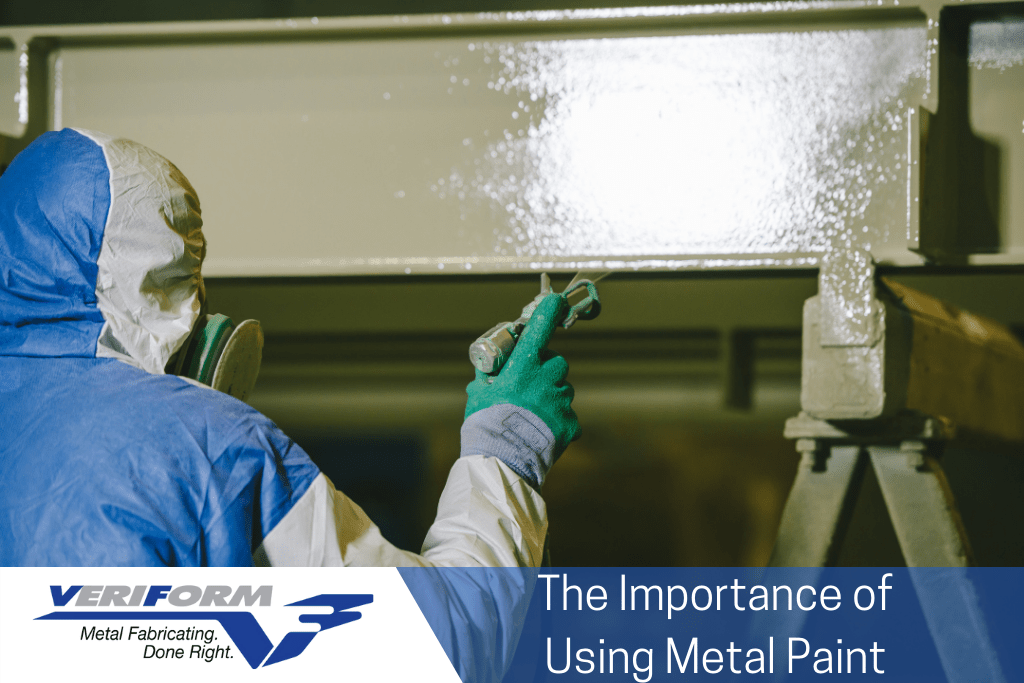
When your metal projects come out of the foundry and into the wild, it is automatically subjected to Mother Nature’s harshest conditions. Depending on where the piece of metal is located, it will get subjected to heat, snow, rain and other weather conditions. These aspects can take a toll on any metal (some worse than others). Metal paint doubles up as a shield to prevent exposure to the elements. Nowadays, some paint does more than just create a layer of protection from the elements.
Metallic oxides help in turning the metal into an ice-phobic surface that prevents the formation of frost. Also, what colour gets used also plays a part in protecting the subject from elemental exposure. For example, choosing a lighter colour on your metals can help lower the temperature and prevent heat exposure. Extra-white paint is known to reflect up to 98% of the sun’s rays. This can help you save on your HVAC fees for the entirety of the location.
Reduce Corrosion
The worst-case scenario for any metal fabrication project is when the metal corrodes due to external reasons. Corrosion refers to the gradual destruction of materials from chemical or electrochemical reactions caused by certain environments. Steel, for example, can easily rust when the iron particles in the metal get exposed to oxygen and moisture in the air. Corrosion in any form always results in breakage, so you should always find a way to save your metal structures from corroding.
When metal paint is used, it forms a layer of protection that prevents corrosion. It may not be that thick, but it is a dependable layer that prevents outside chemicals from interacting with the steel. Therefore, ensuring your metal projects are more durable in the long run.
For Aesthetic Purposes
Another reason why metal gets painted is for aesthetic purposes. When a piece of metal gets painted, it adds to the structural beauty of a building and adds a bit of colour to the place. Adding metal paint to metal sculptures can also help people distinguish between certain subjects. The colour can also affect the mood of the site. That is why most modern-day buildings with exposed metal parts always consider the colour of the metal during the design phase.
Aesthetic-wise, it also plays a part in contributing to the brand of the company. Picking specific colours from a company logo, for example, will help differentiate between your business and the competition. Choosing specific colours can be a form of symbolism and representation as well.
Consult With VeriForm
Painting metal is more than just a stylistic choice. It offers protection and extends the lifespan of certain metal structures. However, it may need some expertise to pick the right kind of metal paint to use and to paint the metal correctly. It’s your best bet to discuss the details of metal painting with a professional instead of DIY-ing it.
VeriForm is a metal fabrication and processing company based in Ontario, Canada. They are a trusted name in metal parts fabrication, machining, welding, and rolling, with over 24 years of experience in the industry. For all your architectural or manufacturing needs, you can rest assured VeriForm has your best interest in mind. Speak with an expert from VeriForm today for more information.
Sheet metal fabrication is a complicated process that produces significant results. Nonetheless, we see improvements in the technology, the practice, and the science showing no signs of stopping. Today, we consider sheet metal as one of the most essential building materials, especially for the manufacturing industry as well as many other industries. Typically, sheet metal is fabricated from aluminum, nickel, tin, steel, brass, titanium, and even copper. But how important is the metal you choose in sheet metal fabrication? Let’s talk about all of that below.
What is Sheet Metal Fabrication
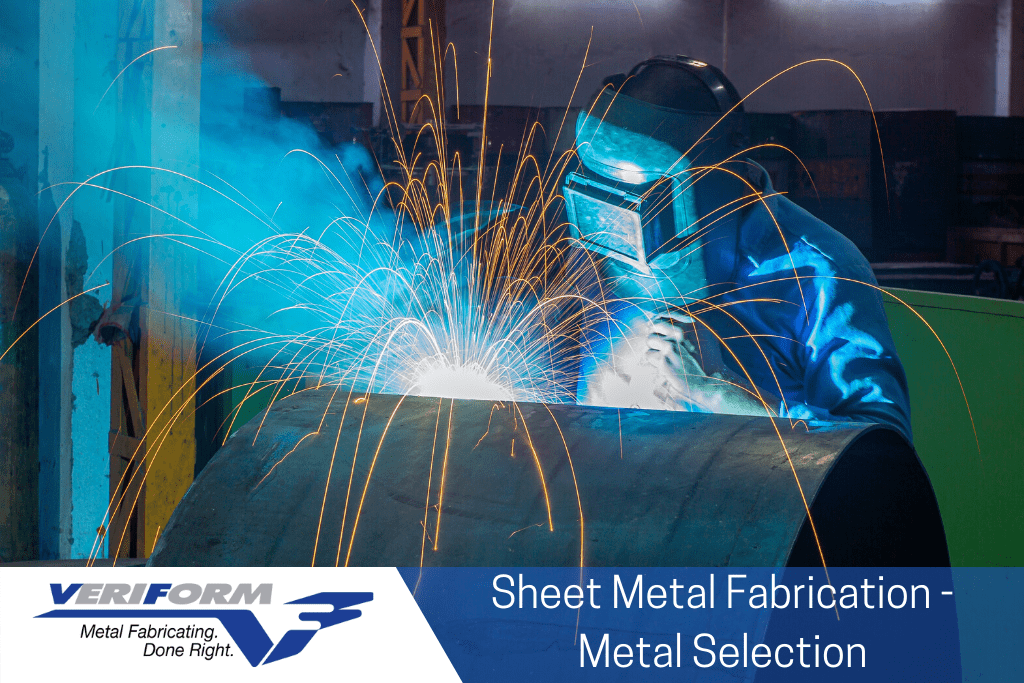
To simply state, sheet metal fabrication is the process that transforms flat sheets of metal (usually aluminum or steel) into different products or structures such as pipelines, or building parts. The sheet is changed either by punching, cutting, assembling, and/or folding it. Sheet metal might also be bent, cut, or stretched to any shape by burning or cutting the metal. The sheet metal fabrication process employs several tools from saws, cutting torches, and press brakes. These tools are used to transform the sheet metal into whatever form it will take on next. The company VeriForm has an excellent set of tools for sheet metal fabrication, and you can check out their processes along with past projects here.
The Importance of Metal Selection in Sheet Metal Fabrication
The type of metal you use for sheet metal work is significant as it can affect how well it will serve its purpose. That is why picking the type of metal to be used is the first step in any manufacturing process. But why?
There are a few factors that can affect the type of metal a manufacturer will use for production. These can include:
Price
Mechanical attributes
Environmental considerations
Physical properties
Chemical properties
These factors will make it easy for the manufacturer to pick a suitable metal for the job. Different metals react differently when worked on or manipulated, so the choice should be deeply considered. If the manufacturer chooses the wrong metal, the product will fail at the manufacturing phase. This is because the material they choose should retain its physical properties and maintain its strength during the whole process. It will also play a part in how long the structure can stand wear and tear. However, if suitable materials are chosen, you will get a product with a competitive edge thanks to its endurance, quality, mechanical properties, and performance.
Different Metals You Can Use for Metal Fabrication
Stainless Steel
Stainless steel is a common term to refer to any variety of sheet metal that contains at least 10.5% chromium. However, there are different grades available with other properties. The most common are the ones that are corrosion resistant. Regular, ordinary stainless steel does not need heat to be processed.
Pros
Chromium additive gives it a corrosion-resistant finish.
Solid and durable for everyday use.
Available in a variety of hardness levels, thicknesses, and widths.
Recyclable.
Easily machinable.
Weldable and can be used for riveting or soldering processes.
Cons
Thick welding points may create corrosion points.
Easily chips.
More costly compared to other options.
Requires a lot of polishing and finishing to be presentable.
Spring Steel
Spring steel refers to several high-yield strengths of steel. This includes low-alloy manganese high and medium- carbon steel. Notably, spring steel is most often used in creating springs. The material tends to return to its original shape after load-bearing or twisting.
Pros
High yield strength and does not change shape when compressed or twisted.
The unique ability to be shaped, formed and post heat treated.
Cons
Not suitable for welding.
It might be challenging to work with in a tempered and hardened state.
Overheating can cause the metal to be brittle.
Aluminum
Aluminum is considered to be a pure metal that can easily be alloyed with other materials. It is not magnetic and is not combustible. It’s also a good conductor of electricity. Aluminum is corrosion resistant and is easy to process. Lastly, it is also non-toxic making it perfect for a variety of applications.
Pros
The non-toxic property makes it perfect for food exposure.
Excellent heat conductivity.
Non-combustible and reflective making it perfect for lighting applications.
Corrosion-resistant.
Cons
More expensive than other options
Not as strong as steel
It can affect the taste of food at times.
Contact VeriForm
If you are looking for a trusted name in sheet metal fabrication in Ontario, Canada, VeriForm is your best bet. VeriForm has 24 years of experience in the process of fabrication and continues to provide quality service to all customers. The experts at VeriForm can help you determine the best metal selection for your project and more. They will provide you with the best options based on the needs of your project and produce great lasting results. Choosing the right metal can ultimately reduce your costs and expenses as well as ensure your structure lasts. Visit our website to find out how we can help your next metal fabrication project.
Custom metal fabrication involves creating something out of particular metals with unique and specific requirements outlined by customers in various industries. Whether that’s cutting and bending metal to create certain shapes or welding and bending metal parts together. The vast array of custom metal fabrication tools facilitates the process of achieving accuracy in the design and dimension of various metals – such as carbon steel, stainless steel, and aluminum to mention a few.
These tools used by fabricators to attain precision and meet desired requirements are used for:
Framing
Laser Cutting
Welding
Punching
Drilling & more
However, one size doesn’t fit all in the metal fabrication process and this is apparent in the variety of metal fabrication tools utilized to get neat cuts and precise dimensions. Some of the tools are; grinder, wire cutters, drill bits, and downdraft cutting tables to list a few. In custom metal fabrication, the era of 2D and 3D modelling through the SolidWorks platform has become a conventional technique commonly used by fabricators.
SolidWorks & Metal Fabrication Accuracy
Machinists and fabricators comprehend the importance of design and accuracy in custom metal fabrication and as such imbibe the use of SolidWorks from the mill to inspection and engraving stages. SolidWorks encompass a 2D model for cutting, milling, turning, inspection, and engraving. The 3D model allows for computerized machine fabrication with cloud-based integration. During the preparatory and development stage, SOLIDWORKS CAD and Finite Element Analysis are imperative to building and virtually testing processes.
SolidWorks Features
The diverse features of Solidworks, especially 2D and 3D modelling, provide ease in sheet metal fabrication and additionally bolsters productivity & profitability. Other SolidWorks features include:
Weldments
Conceptual Design
Large Assembly Design
Mold Design
Configurations
In the aspect of design, the accuracy of the tools reduces leftover scraps and ultimately improves the quality of the end product. However, in other situations, machine accuracy is easily achieved after digital adjustments are made. Top-notch surface finish and punching equipment used in fabrication achieve precise cuts and finishes.
With the virtual design, a fabricator can seamlessly communicate with clients to keep them involved every step of the way. It also allows for smooth and easy adjustment of design; to add new features or make corrections. All of these advantages are useable in the development of custom metal fabrication.
A Cut Above Commitment – VeriForm
VeriFormis an industry-leading fabricating company with in-depth experience in CWB welding, structural pipes, and rolling sheet metal. At VeriForm, we manufacture under the ISO quality system. VeriForm uses platforms and tools like SolidWorks to provide our valued customers with accurate and detailed engineering drawings to ensure we know exactly what you want to satisfy your needs. ContactVeriForm to learn more about our custom metal fabrication tools and processes. Learn more about our innovative fabrication equipment such as the Horizontal Pressbrake and a host of many other state-of-the-art fabrication tools for bending various metals.
“Among the many measures the world can take to wean itself off fossil fuels, few match the benefits of making homes, business, and cares more energy efficient. But financial and psychological barriers have kept individuals, businesses and governments from realizing efficiency’s great potential.” – Jon Luoma
Paul Rak along with his company VeriForm Inc. was recently featured in an article written by Jon Luoma and was published at the Yale School of the Environment. This article shines a light on Paul Rak’s decision and investment towards becoming a more energy-efficient Canadian metal fabrication company. It also touches on subjects such as financial and psychological barriers that have prevented companies from fulfilling the energy efficiency promise.
Since 2006, Paul Rak was inspired to do whatever he can to cut his company’s greenhouse gas emissions. After investing $46,000 in energy efficiency, the company immediately benefited from this decision after a return on investment of $90,000 from reduced energy bills annually. That comes out to approximately 200% return on investments. Since then, VeriForm Inc. has been able to cut energy costs by 58%. They’ve also reduced its greenhouse gas emission by 233 metric tons per year. The Canadian government recognized his efforts and granted Paul Rak a $100,000 award. To learn more about how VeriForm and other companies are taking steps towards a greener future, follow the link below.
At VeriForm, we are very proud to announce that we are the recipient of the 2020 Net Zero award that’s presented by Sustainable Waterloo Region!
For the past six reporting years, VeriForm has maintained an absolute net-zero inventory. In 2020, GHG emissions were reduced by 75%. Evidently, only 25% of our emissions were offset compared to the year 2006. VeriForm also goes above and beyond when it comes to reporting. We also include all the information that we have along with information on Scope 3 emissions that are optional in the sustainable program structure.
This award recognizes a member that has reduced and/or offset their entire greenhouse gas emission inventory. It also demonstrates the member’s success in maintaining a zero inventory for one or more reporting years. *Taken off sustainablewaterlooregion.ca website.
At VeriForm, it continues to be an honour to represent sustainability in our community. To view our award on the Sustainable Waterloo Region website, click here.
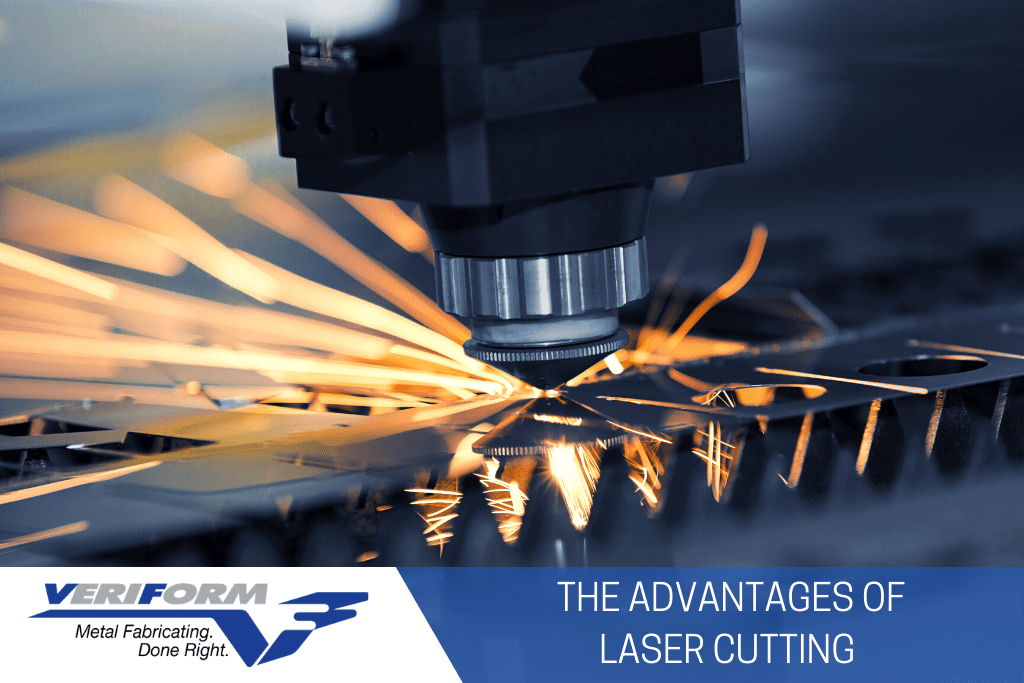
For quite some time now, laser cutting has emerged as an optimal choice in metal cutting techniques. The field of mechanics, robotics, and IT has coalesced to replace the manual approach with computerized machines to achieve precision and high-quality smooth finish in metal cutting. Nowadays, bringing digital designs to reality in metal fabrication uses CNC laser cutting methods. In many industries such as construction and manufacturing, lasers are used to cut through steel, aluminum, tungsten, and nickels to name a few. To learn more about the advantages of laser cutting, continue reading.
Advantages Of CNC Laser Cutting
With the use of laser optics and computer numeric control, metals are cut smoothly according to preset measurements. This process entails a laser beam that melts through metals or vaporizes the metal leaving a smooth and clean cut behind. There are many advantages of laser cutting such as being an ideal tool replacing plasma cutting. Laser cutting gives more precise cuts using less energy.
Versatile Application
One of the major reasons why VeriForm advocates and incorporates the use of laser cutting techniques is due to the versatility it offers in metal cutting. The laser beam is universal and is used to cut through different metals, shapes, and thickness all while not requiring any changes. For this reason, it’s even applicable to achieve intricate and detailed cuts without any unnecessary tool changes need. CNC laser cutting doesn’t require any custom-built tools in order to complete your projects.
Precision & Repetitive Process
One of the obvious advantages of laser cutting is the precise cuts it gives compared to other forms of thermal methods or the outdated manual method. It uses an extremely small but powerful laser to complete a variety of projects. Once the accurate measurements have been set, the same dimensions can be efficiently repeated on subsequent metals cut by the laser. This repetitive process takes us to the next advantage, and that is speed.
Speed & More…
Experts at VeriFormhammer on the speed laser cutting gives compared to mechanical methods particularly. The advantage of the speed becomes more pronounced in achieving complex metal cuts. Plasma and flame cutting methods perform below par in terms of thick cuts. Laser slices through thick metals faster and more accurately. Other supplementary advantages include quality cuts and automated systems that require less human control to avoid unwanted errors. CNC laser cutting done right causes no damage or warping to even thin metals. Fewer mistakes mean less metal wasted, which in turn, saves you more on production and material cost.
Contact VeriForm For CNC Laser Cutting
In conclusion, large-scale industrial metal sheet cut, CNC laser cutting proves a lot more beneficial and practical. The industrial metal cutting and fabrication process require accuracy of the highest quality. To get such, the use of laser cutting plays a huge role.
At VeriForm, we work hard to provide top-notch sheet metal fabricating services for different sectors. Ultimately, we incorporate laser cutting to obtain clean and precise cuts. This ensures prompt delivery while taking advantage of the speed laser cutting provides. Contact us today to get a quote. Visit VeriForm to learn about our services; best cutting practices and our standards of operation. We guarantee that we’ll provide a cut above commitment.
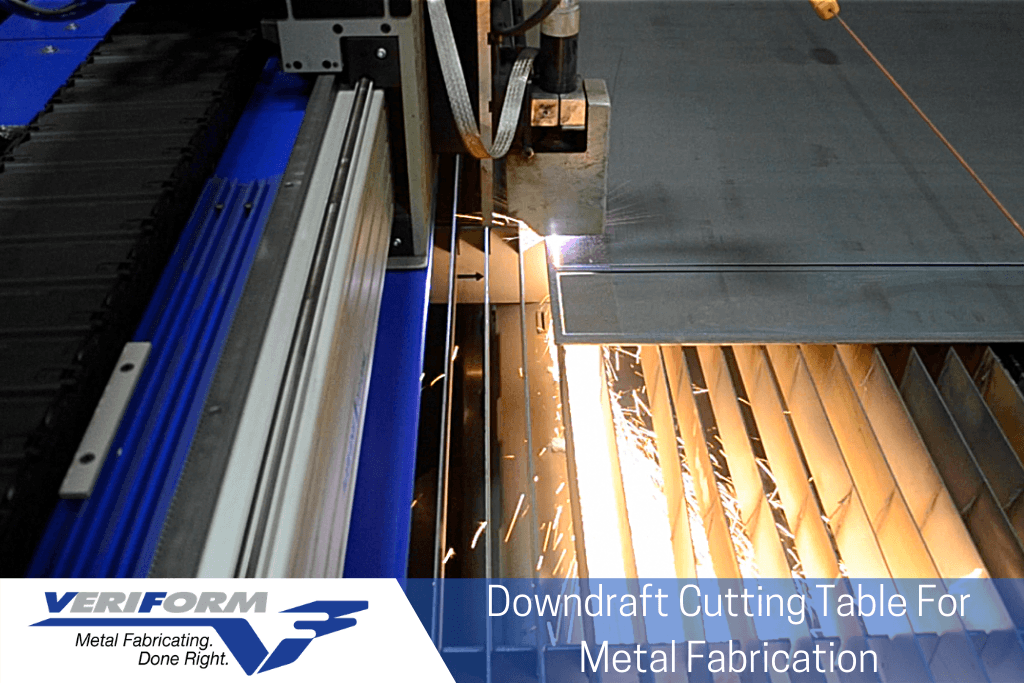
During certain processes such as metal fabrication and woodworking, it is essential to control the dust and fumes surrounding the work environment. One highly recommended solution is a downdraft table, where air flows down through the table and pulls dust and fumes away from your operating area. Get more uptime from VeriForm’s mechanical design, and superior smoke and dust removal by purchasing a downdraft cutting table. These systems are built for long, dependable service with lower operating costs and downtime.
How Does A Downdraft Cutting Table Work?
The concept of a downdraft cutting table is to pull air from the plasma plate, below the table so that none of the plasma smoke will escape. This allows materials to be cut more efficiently and draws all the toxic fumes and dust away from the operator. See how it works. Improved ducting underneath the cutting table cuts dust collection costs by 70-80%. Not only do you get to breathe easier, but you also save money from the increased uptime.
The tables can be custom-built, depending on the client’s needs. They’re customizable and multipurpose ranging in various sizes. Not only do the workers get to breathe easier, but money can be saved from the increased uptime. They can localize smoke removal right at the source for better dust and pollutant extraction throughout the table. Not only does it improve the health of your employees, but the service life of the components and electronics will also be longer as well. Higher dust recovery rates mean more productivity and less time spent cleaning.
Why Should You Have One?
If you are not using a downdraft table, you will most likely be using a water table. Water tables tend to be messier and involve more cleaning. Using a water table can make cutting speeds slower and less productive especially if water gets in the way during a cut. The further downsides to water tables can be the fact that they are more difficult to clean and maintain. Water exposed to colder temperatures can freeze, and it requires regular treatments to avoid potential health hazards. There is also the risk of explosion when plasma, aluminum, and water react together.
Besides making water tables obsolete, downdraft tables can lower certain health risks such as lung and throat cancer, asthma, bronchitis, and other serious diseases. These are all valid reasons as to why you should consider purchasing a downdraft cutting table for your workplace.
A Long-Term Investment Worth Investing
Upfront costs may be higher, but with the added productivity from purchasing your very own downdraft cutting table, you can experience savings in annual costs and return on investments. Let your employees work better by equipping them with the proper work environment and equipment. To learn more about the benefits of downdraft systems and other metal fabrication inquiries, contact VeriForm today. Experience our commitment to our customers first-hand.
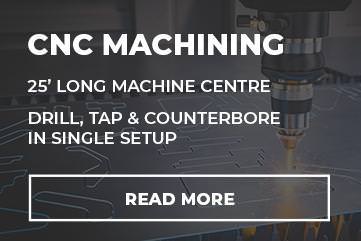
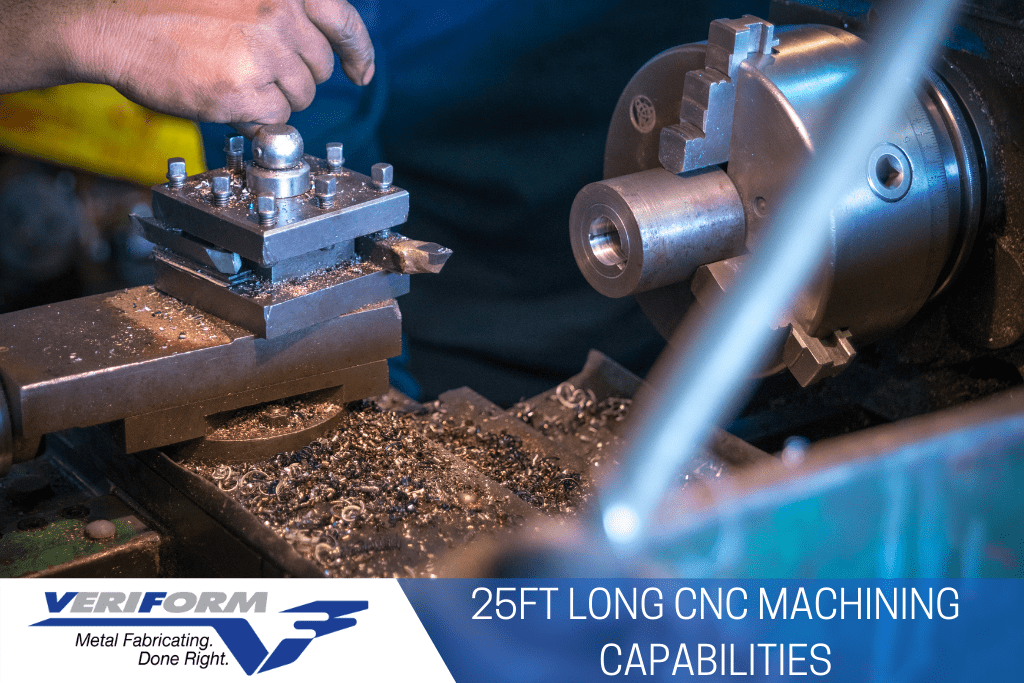
Long gone are the days of traditional machining. Computer Numerical Control (CNC) is a process where an operator implements metal manufacturing instructions using a computer console. During the past 24 years, VeriForm has remained dedicated to our customers. We’ve made an everlasting commitment to our core values: community, sustainability, and education. In our continued efforts to be leaders in precision sheet metal fabrication services, we are excited to announce our new Canadian 25ft long CNC Machining Centre, an upgrade from our previous 20ft long.
Benefits Of A 25ft Long Machining Center
Finally, the longer CNC Machining Centre is capable of milling and drilling your larger parts with less repositioning. This successfully grants more efficiency and better productivity for our valued clients. Our new drilling machine now offers drilling, milling, tapping and other processes on larger parts, which the smaller 20ft long machine could not handle. The 25ft long machine center can now machine an XY Axis up to 2ft x 25ft. After decades of experience, we understand that there is more to be done and productivity is second to none. Discover if CNC Machining is right for you.
CNC Machining Operations Available At VeriForm
Our Machining Centre at VeriForm is long enough to have multiple workstations duplicated, which ensures high uptime and productivity. The following machining operations are available:
CNC Plasma Cutting: Create 2D shapes and figures from sheet metal with high temperature and high-velocity streams of ionized gas.
Tapping: Internal threads (up to M40 Thread) are created in the product so that fasteners can be used to connect parts easily.
CNCBoring: Drills circular internal profiles in a hollow piece or on a hole.
Milling: Progressively removes small chips using a rotating cutter tool.
Slotting: Cutting common shapes into a straight slot (rectangular or square), or a keyway, locking slot that is curved on the end.
Drilling: Drills holes into metal pieces, up to 1.5” diameter.
Beveling: There are many critical issues to address when beveling. From the degree of the angle to the length of the bevel, it requires various levels of cutting tools, years of experience and skill sets. It’s the process used to prepare metal for a welded seam. At VeriForm, prepared parts can be welded by adding a bevel on weld joint parts. Our bevellers include a Pullmax X97, Heck 9000 or Trumpf handheld unit.
CNC Countersinking: Allows screw heads to “sink” into the metal rather than protrude from the outer surface.
VeriForm Will Continue To Improve
In the meantime, continuous improvement is never-ending and our 25ft long CNC Machine Centre is a step in the right direction. As technology continues to advance, so will VeriForm. Without delay, VeriForm offers personalized services within 24 hours of initial contact. Our goals to become greener, and 98% or better for on-time delivery is some of our next step towards that improvement. VeriForm has committed to your success for at least 24 years now and they will continue to meet our client’s expectations when it comes to quality metal fabrication. Experience a cut above the rest and contact VeriForm today for more information.
Metal fabrication or metal working is the process of turning raw metal into completed products or certain parts of products. It is also used to create metal designs for large structures and applies to simple items as well as precision-engineered metal items. The desired end result requires different processes using a range of metals. It is a specialized process that requires specific equipment, training, knowledge, and skills.
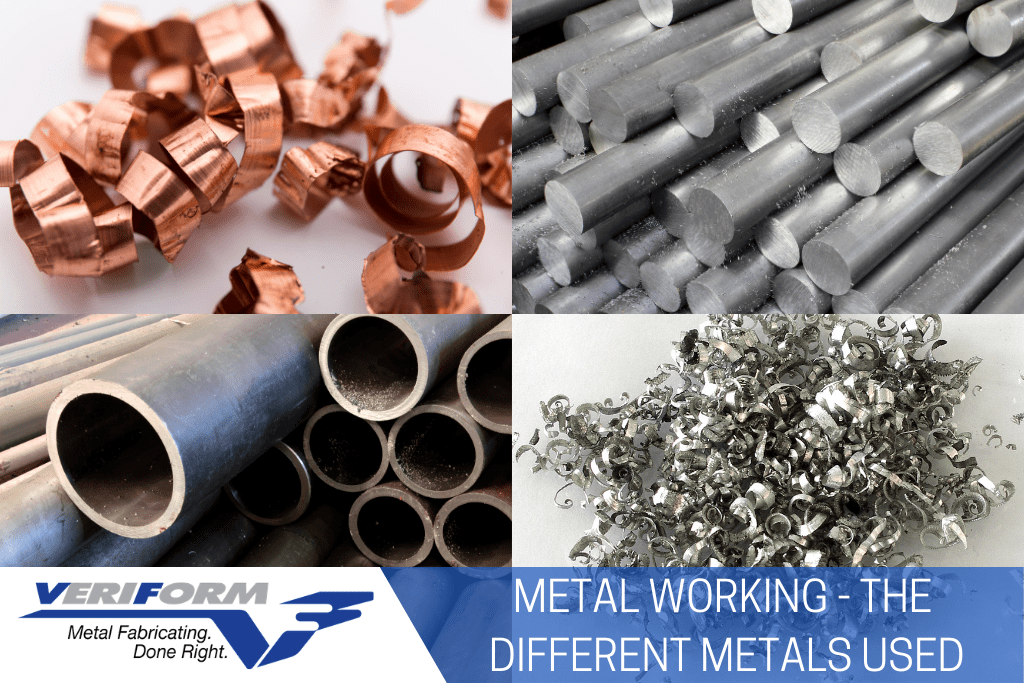
Different Metals Used For Metal Working
Depending on what the item is to be used for and how it will be used, different metals are required. Each has advantages and disadvantages so it is important that the best and most suitable metal is used for the best results. Consequently, using the incorrect metal could spell disaster for your project and cost you more in the long run. An expert, experienced in metal fabrication will be able to advise you of the best option. To further explain, here are a few of the more popular metals used, their characteristics, as well as a few examples of where they are used.
Common Metals Used
Aluminum: This is a popular option as it is lightweight and affordable. Aluminum isn’t as strong as steel but still delivers good strength if fabricated and used correctly. Additionally, another important advantage is extreme resistance to corrosion. It does not like extremely high temperatures but can handle low extremes well. Metal working often uses aluminum for casings, refrigeration, panels and aeronautics.
Carbon Steel: The most commonly used material in fabrication is carbon steel. Carbon steel is extremely strong yet malleable. It has a low melting point and is highly durable. It’s used for a range of parts and is often used in larger structures needing superior strength. It is weather-resistant and durable.
Stainless Steel: Stainless steel is versatile and a popular choice for cookware, surgical instruments, fittings, and appliances. A combination of carbon steel, aluminum and chromium are what make up stainless steel. This gives it strength and durability as well as a good lustre. It is resistant to corrosion and does not leach or contaminate what it comes into contact with.
Copper: The main benefit of copper is that is an excellent conductor. It’s a great option for sheet metal fabrication. Copper is malleable, making it easy to manipulate. It is corrosion-resistant and often used in electrical products, industrial settings and in marine applications.
Magnesium: Automobiles and aircraft parts use magnesium. It is also suitable for high-pressure die casting. The reason for this is that it has a very low density making it light and relatively strong. It’s also good for corrosion resistance and castability.
VeriForm Inc.
If you are looking for a dedicated company to assist you with your metal working needs, you need to ensure that you work with a reputable company. VeriForm is a well-established metal fabrication company with a proud 23-year history. The company has built its great reputation on the core values of:
Community
Sustainability
Education
They operate under the strict ISO 9000-2015 quality system and offer full metal fabrication services. This includes metal rolling, welding, bending, precision plasma cutting, and other types of metal working. They have the skills, experience, and resources to tackle jobs of all sizes. In addition, they offer the following specific services:
Parts Fabrication: Aluminum, Carbon Steel, Stainless Steel
Bending
Rolling: Metal Rolling, Sheet Metal Rolling, Structural Rolling
Welding: Shielded Metal Arc Welding, Gas Tungsten Arc Welding, Gas Metal Arc Welding, Pulsed Gas Metal Arc Welding
The company is based in Cambridge, Ontario and is committed to delivering top-notch quality service and customer satisfaction. VeriForm continues to build on its past success and strives to constantly improve and innovate.
Metal Working For You
While quality metal is essential in any project or product, the quality of the workmanship is just as important. VeriForm has proved itself over more than two decades and is a master at metal working. No matter what industry you are in or the size of your project, contact VeriForm to see how they can assist you. A quick visit to the VeriForm website will give you specifics on all of their services and capabilities. It will also show you examples of some of their work as well as more details on the company itself. Do not leave anything to chance and stick to a trusted company you can depend on.