VeriForm has always been committed to three core values: the community, sustainability, and education. This year, VeriForm has decided to give back to the community. We’re excited to announce that during this holiday season, VeriForm has now become one of the sponsors for the Rotary Club of Hamilton. Every year, the Rotary Club of Hamilton hosts a Children’s Christmas lunch. This lunch will feed and put smiles on the faces of over 500 children!
On December 16, 2021, the Rotary Club of Hamilton will be hosting its signature event at the Cathy Wever Elementary School. This event is to promote engagement within its community. The Cathy Wever School has focused on the education of many inner-city kids of Hamilton including refugee children that comes to the city.
This festive day will provide plenty of exciting entertainment, fun and a good old fashion turkey dinner for the children. There will be a warm meal and gifts along with a book for every child. All thanks to the generous sponsors and volunteers who have dedicated their time and efforts to this cause. However, this event wouldn’t be possible without the help of the community.
How Can You Help?
The holidays are all about sharing love and giving back. If you’re also interested in this cause, there are plenty of ways you can help. The Rotary Club of Hamilton is currently accepting donations and every little bit counts!
Did you know that $20 could allow you to reach the Virtual Stockings level? A virtual stocking will help feed 3 children and provide them with a Christmas goodie bag to take home. There are various levels you can reach depending on the amount you wish to donate such as:
Elf Sponsorship Level – $250
Snowman Sponsorship Level – $500
Reindeer Sponsorship Level – $1000
Santa Sponsorship Level – $2500
Each level will provide even more wonderful surprises for the children along with the equipment and PPE to make this event successful. If you’re looking for more information or if you’d wish to provide some support by donating please visit this link: https://rotaryclubhamilton.ca/
Strengthen Your Community with VeriForm
Ultimately, children are our future. There’s no better way to give back to the community than by investing in our future and the Children’s Christmas Lunch is a great place to start. VeriForm is always happy to support local causes and has contributed in the past. To read more about what we have done for our community click here.
As always, VeriForm is one of the leading metal fabrication companies in North America. When it comes to metal fabrication, you’ll always want to support a business that not only delivers quality results but also a business that strengthens the community. With their state-of-the-art technology and a capable team of experts, getting the job done right the first time will never be an issue. For all your metal fabrication needs, contact VeriForm today.
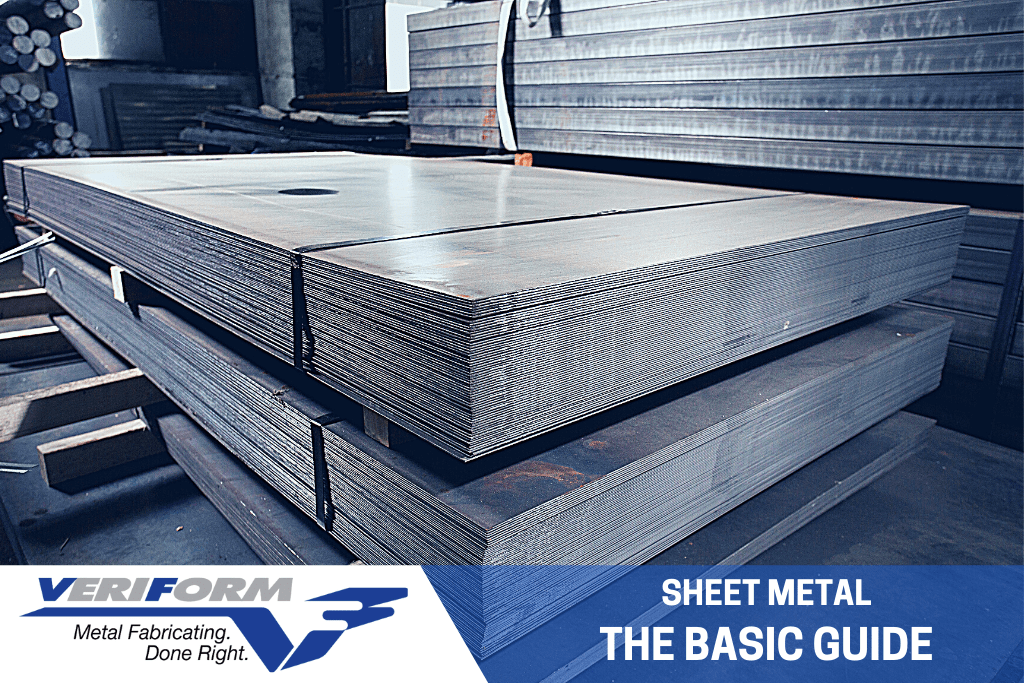
Sheet metal is essentially any type of metal that’s been forged into flat pieces of various thicknesses. It can be cut into different sizes and shapes and is used to create and complete a variety of metal fabrication projects. Today, it is among the most adaptable building materials. It is used everywhere from machinery and vehicles to house furniture and facades. Read on to learn more about the different types of sheet metal and how you can choose the most suitable option for your next project.
The Importance of Sheet Metal & The Different Uses
Sheet metal provides you with many advantages compared to other fabrication materials. Besides its use in construction, you can use it for DIY or home improvement projects as well. However, different metals have different properties and characteristics along with different melting points. So, selecting the right material is important to ensure your project succeeds.
People use sheet metal because of its remarkable characteristics. For instance, it is very affordable and easy to use. Also, it is flexible which gives you more options when it comes to certain processes like bending. The options surface when creating complex and simple designs.
You can purchase specific sizes and shapes which does result in relatively low waste. In addition, the technological advances in modern fabrication make the designing process much easier than it used to be. A good example is the use of computer-aided design (CAD) programs which allows you to create the design on the same material you wish to fabricate.
Different Types of Sheet Metal
Sheet metal is made from different types of metals for different applications. As it was mentioned before, different metals have different properties which could drastically affect your needs. If you choose a metal with a high melting point like copper, you know you won’t have to worry about it melting when there’s heat involved during processes like welding. The same can’t be said for metals with low melting points.
Will your metal structure be subjected to external environmental factors? Will it rust or corrode over time? Consider these factors when you’re choosing the type of sheet metal you’ll need. Here is a look at the three common types.
Stainless steel is a popular metal to use because of its anti-corrosive properties. It contains at least 10.5% chromium which makes it resist corrosion. Besides, stainless steel is durable, easy to fabricate, and delivers a sleek appearance.
Among the various stainless steel grades, 304 is most often used for homes. Grade 316 is used in marine applications and is obviously more expensive than grade 304. The most common uses for stainless steel are during construction, transportation and foodservice applications.
Aluminum can also resist corrosion when it interacts with various non-acidic liquids. Also, it is a very light metal; making it the preferred choice for making cans, aluminum foil, window frames, kitchen utensils, and beer kegs. What’s more, aluminum is easy to recycle.
Grade 5052 is one of the stronger aluminum alloys that are corrosion-resistant, weldable, and formable. Another aluminum grade is grade 6061, a solid structural alloy often used in high-strength parts such as marine and truck frames or extrusions.
Often known as industrial steel, this steel alloy combines iron and carbon. The commonly used form of carbon steel is low-carbon steel. It contains less than 0.25wt% of carbon content. Compared to high-carbon steel and medium-carbon steel, low-carbon steel is relatively soft. Which means it’s easily malleable. However, it is more ductile which makes it perfect for low-cost welding and machining.
Although these three tend to be the most common types of metal, there are other types as well depending on the application. Other types of metal include:
Brass
Copper
Tin
Nickle
Titanium
Metal Fabrication Services That Requires Sheet Metal
Practically all metal fabrication processes require the use of sheet metal. However, certain services seem to use it more than other processes. Here are metal fabrication services that require the use of sheet metal the most.
Welding
Bending
Spinning
Shearing
Stretching
Flanging
Punching
Metal Fabrication Services — VeriForm
If you need professional help fabricating metal parts, then check out VeriForm today. VeriForm is a Net-Zero North American metal fabrication company that offers many services. Their team of experts and engineers has been completing metal fabrications for over the past two decades. They have state-of-the-art tools and equipment that allow them to professionally perform many capabilities on a variety of materials. Their highly-skilled fabrication team makes sure your parts are done right the first time. Regardless of how complex your parts are, the high-precision equipment ensures your parts are flawless. Do not hesitate to contact VeriForm for aluminum fabrication, carbon steel fabrication, stainless steel fabrication needs and more.
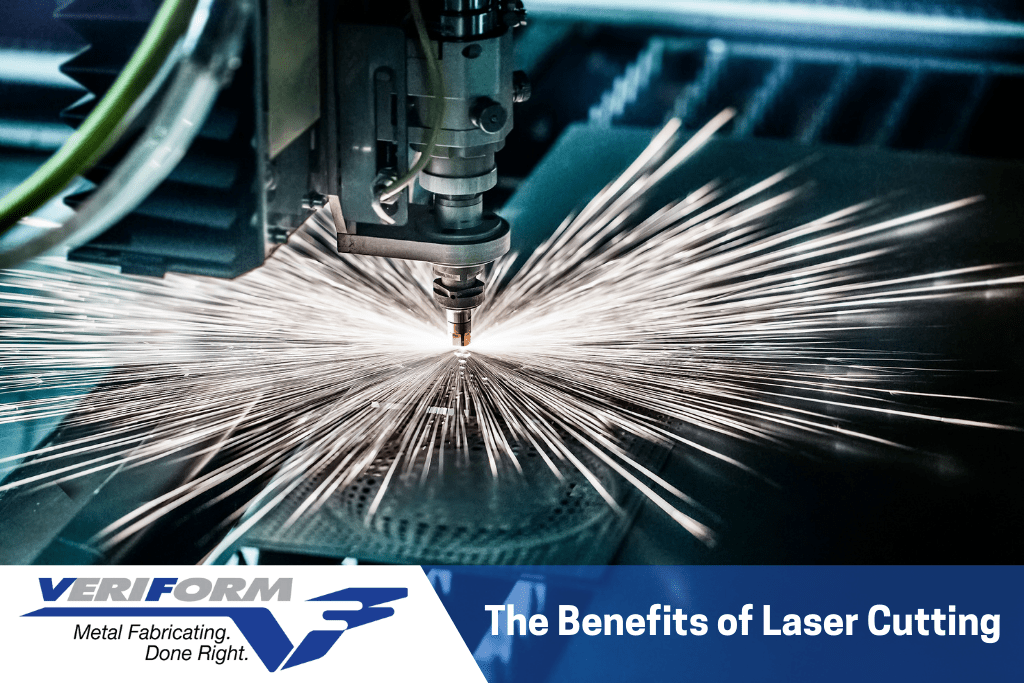
Laser cutting is essentially a fabrication process that requires a focused and narrow laser beam to create specific cuts and etches of custom designs, and patterns. The laser includes a very high-intensity light, of a certain wavelength or colour. The high-power laser is then directed through optics such as a specialized lens or a curved mirror and computer numerical control to navigate the beam or material. This thermal-based fabrication process is the most optimal for materials such as wood, metal, glass, and more. As we continue this discussion, we will be guiding you through the benefits of laser cutting and how this process impacts the metal fabrication industry.
Laser Cutting Versus Traditional Cutting
When it comes to laser cutting, there are always misconceptions about the process being too dangerous. However, we will elaborate more on this misconception as we continue to discuss the benefits of laser cutting. For that particular reason, machine operators have opted for other methods of cutting. Besides laser cutting, there are other traditional cutting methods such as:
Waterjet Cutting: Uses pressurized water (sometimes mixed with abrasive grains) to cut.
Plasma Cutting: Uses a conductive and high-speed gas to cut.
Oxyfuel Gas Cutting: Uses a chemical reaction of pure oxygen and intense heat to cut.
Keep In Mind…
Depending on the laser cutter, you’ll want to be cautious when it comes to the materials used for your client’s project. Certain laser cutters reach higher temperatures which indefinitely means that they can burn or melt your material. High-temperature lasers should not be used on wood, plastic or metals with a low melting point like brass, aluminum or copper. With that being said, a different method of cutting is called for. Nonetheless, if you’re looking for great versatility, precision, and quality – laser cutting is what you’re looking for.
Benefits of Laser Cutting
First, we’ll discuss the prior misconception of laser cutting being too dangerous. It’s considered too dangerous because of the powerful beam that could potentially create a fire or cause injuries. Despite the high-temperature laser, laser cutting is one of the safer cutting methods due to numerous reasons.
Less residual fumes are released because they’re enclosed in a chamber, therefore being less detrimental to your health.
The operators aren’t handling any cutting blades making laser cutting much safer than mechanical cutting.
Automation – Laser cutting does not require human intervention due to programming, so the chance of getting injured is obsolete.
Now that we’ve discussed the safety aspect, we’ll continue with other benefits of laser cutting. Laser cutting is one of the most efficient processes. Compared to manual or mechanical methods, laser cutting doesn’t require re-tooling or halting operations to make adjustments – unless there’s something wrong. Once an adequate design is in place, it simply needs to be programmed into computer software and the machine will do the rest. Oftentimes, laser cutters only leave a minimal burr. Depending on the material, it may not even need to be removed hence, greater efficiency. Laser cutters are also known to be precise, versatile, and flexible, creating high-quality pieces in a short amount of time.
Laser Cutting Services at VeriForm
If you’re looking for premium laser cutting services, then VeriForm is your best bet. At VeriForm, experts have been using CNC laser cutting machinery for at least 20 years. They’ve been providing high accuracy cuts on some of the largest pieces of metal in North America. Their laser cutting offers up to 3/4 inches x 80 inches x 160 inches with an accuracy of +/- 0.005 inches. Even if you don’t have the plans, measurements, specifications or prototypes you need, they have a team of experienced engineers that can assist you in creating the necessary blueprints to complete the task. Besides laser cutting, VeriForm also offers numerous metal fabrication services and capabilities including, bending, rolling, welding and more. Contact VeriForm to get an estimate for your cut today!
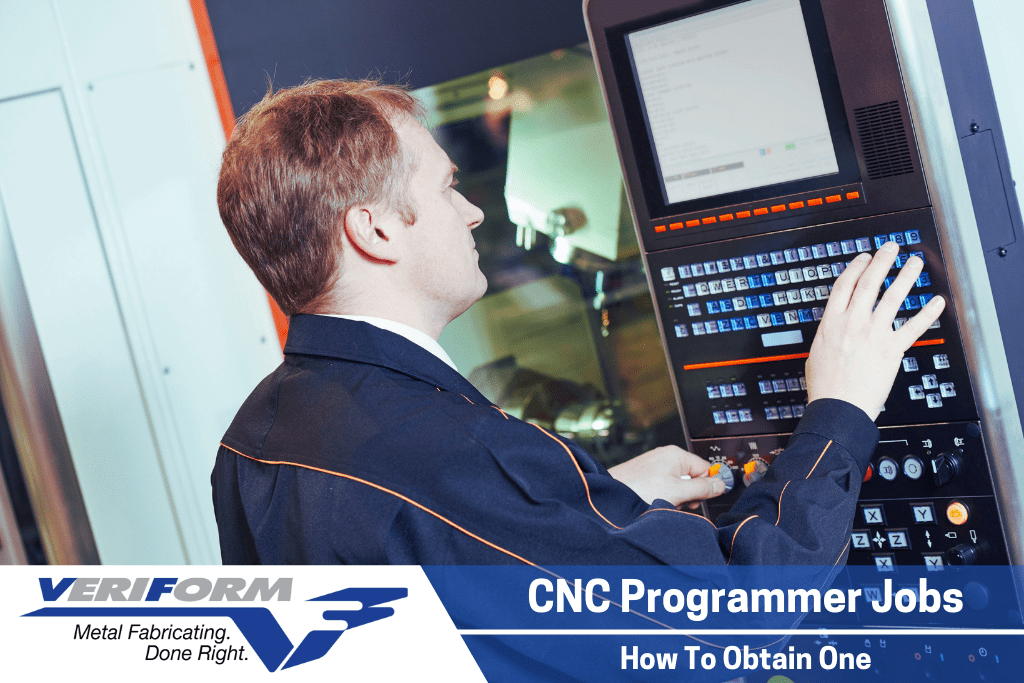
Working as a technician within skilled trades offers a promising career path. With so many avenues to choose from, it can be hard to narrow which trade to pursue. One way to decide is to measure the anticipated growth for in-demand roles. That brings us perfectly to the role of a CNC Programmer. According to The Bureau of Labor, CNC Programmer jobs are expected to grow by 16% through 2026. But what exactly is a CNC Programmer? A computer numerically controlled (CNC) Programmer uses computers to control machinery in ways that cut raw materials into functional items or components of larger items.
Benefits To Becoming A CNC Programmer
A CNC Programmer is desirable due to its transferability among industries. Think of it this way – there’s a need for CNC Programmers in industries that require specific, customized parts to assemble large-scale items, all by using machinery. From aerospace to automobiles, and from medical to defence. CNC Programmers guide machines by using computers to get stuff built. It’s the perfect blend of using complex problem solving to produce something tangible. Simply speaking, job opportunities are widely available due to the many industries that require a CNC programmer.
A CNC Programmer’s Educational Requirements
CNC Programmers are becoming increasingly popular, as manufacturing evolves to meet our technological needs. Thus, there are CNC Programmers in both general and highly specialized roles. One other benefit to becoming a CNC programmer is the fact that on average, many CNC Programmers only require a high school diploma. While certain employers might require a Bachelor’s Degree in Engineering, it is understood that the more you aim to specialize – the likelihood of requiring additional certificates, training, or Associate’s Degrees increases within the area of expertise. The same thing could be said regarding the wage. A CNC programmer can obtain a wage ranging from $15 – $40 per hour depending on your level of expertise, experience and education.
Expected Tasks From CNC Programmer Jobs
CNC Programmers conduct an array of tasks requiring both technical and problem-solving skills. From interpreting project blueprints to designing programs to build specific components. CNC Programmers play a crucial role in product assembly and project completion. Specifically, CNC Programmers will ensure machine functions line up with project designs and drawings. They’ll ensure computer programs can tell machinery to conduct job-specific functions such as cutting materials. They’ll also make recommendations to improve computing and machining processes, resolve issues with machines, and conduct any maintenance issues that arise with either computers or machines.
Getting The Job – Contact VeriForm
According to leading CNC Programming professionals, the best way to secure CNC programmer jobs is to make connections. In other words, network with other CNC Programmers and industry leaders. One reliable suggestion would be to ask “why” related questions. This ensures emerging CNC Programmers are getting a detailed understanding of job-related processes and can put these into transferable contexts.
For interested professionals, one place to start could be by connecting with companies like VeriForm. VeriForm is a Canadian metal fabrication company that uses CNC technology to ensure highly sophisticated designs across a wide array of industries. Whether it’s bending, rolling, or welding metal, VeriForm uses comprehensive computing and machines to build necessary parts and components for their clients. A great career in CNC Programming awaits, visit Veriform today for more information regarding metal fabrication and CNC programming.
We at VeriForm are proud to announce that we are now members of the prestigious Canadian Tooling & Machining Association (CTMA).
The CTMA, established in 1963, is now home to approximately 160 companies employing over 17,000 people. They have multiple chapters with locations in Windsor, Toronto, and Western Ontario. They remain committed to representing, supporting, and promoting the interests of the Canadian tooling and precision metalworking industries. As a key objective, CTMA is committed to promoting and providing programs devoted to apprenticeship training and skills upgrading in the tooling and machining industries. We are so happy to be a part of the CTMA that is sponsoring the training of two out of our three employees undergoing machining apprenticeships to help our staff develop their machining skills and careers.
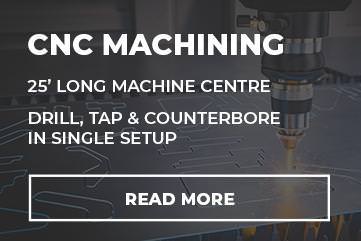
In our 24+ years of operation at VeriForm, we are driven by three core values: Community, Sustainability, and Education. We have grown to become a notable force in the metal fabrication and machining industry. Our services include fabricating various metals, including Aluminium, Carbon Steel, Stainless steel, and others. Thanks to our 177″ and 300″ machining centers, we are capable of high-speed drilling and milling of large and long parts in one setup with less repositioning. With our new 25ft CNC drilling machine, we now offer drilling, milling, tapping and performing other processes on larger parts that our smaller 20ft machine could not handle. We have fabricated various metal parts of different sizes for clients in the mining, forestry, and machine-building sectors of North America. Our Stainless-steel fabrication arm is certified to CSA 47.1 for structural welding of stainless grades ASTM-A-240 and ASME-SA-240, types 304, 309, and 316 stainless by the Canadian Welding Bureau (CWB). Our team of engineering experts is available to design the specifications for the parts you require.
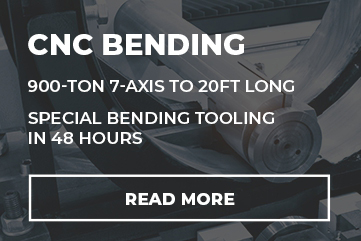
Additionally, VeriForm offers custom architectural fabrication to produce custom shapes and forms required in the construction of luxury homes and commercial plazas. We also provide metal bending services with a capacity ranging from small sizes up to 20-feet long sizes. Our welding team of experts is CWB CSA W47.1 and W59 certified and can weld any shape required for your projects. VeriForm provides metal, sheet metal, and structural rolling services. We have the facilities for rolling metal up to 10 feet in width. We are committed to developing innovative ways to meet our clients’ needs better and quicker. We are well equipped and have machines and equipment for various tasks, including seven cranes, including five and ten-tonne bridge cranes, 6,000lbs and 8,000lbs forklifts, numerous one and two-tonne jib cranes, and five and 10-tonne bundle lifters. We are committed to a net-zero emission goal and operate an eco-friendly, sustainable company.
To learn about how we can help you on your next great project, contact us today!
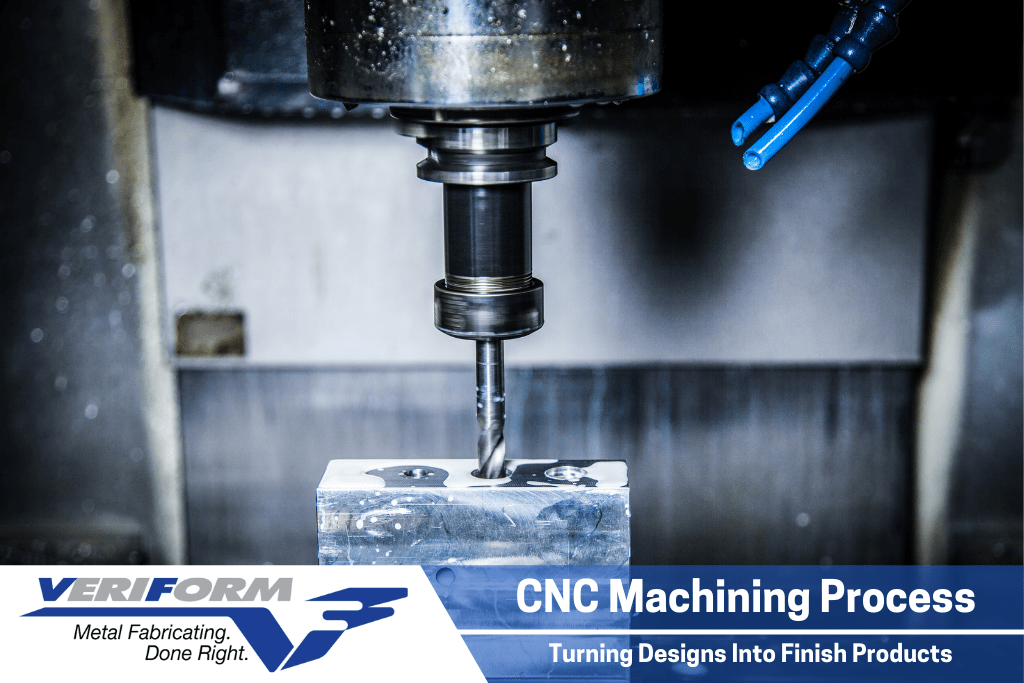
Turning thoughts and designs into finished products requires an extensive process. The CNC machining process can be difficult to understand for those who aren’t familiar with this type of technology and its capabilities. To start off from the very beginning, what is CNC machining? Computer numerical control machining is a manufacturing process that requires pre-programming from computer software to direct the movement of other tools and machinery. CNC machining is used to control a number of complex machinery including grinders, lathes, cutters and mills. It allows for three-dimensional cutting tasks to be completed through a single set of prompts. Due to these capabilities, CNC machining has defied the limits of manual control but what does the actual process entail? Let’s continue to discuss in detail the overall CNC machining process and how designs get turned into actual structures.
From Designs to CNC Operations
To begin the CNC machining process, 2D vector or 3D solid part CAD designs have to be created first. Whether that means getting your designs created in-house or by an external CAD/CAM design company. A computer-aided design (CAD) software is used by designers and manufacturers to produce a model or a rendering of parts along with important technical specifications to produce the structure. However, keep in mind designs are of course restricted by certain CNC machine and tool capabilities. Different tools will have different limitations.
These designs once created, are then converted to a CNC-compatible file format like STEP or IGES. The compatible file format will run through a CAM program that extracts the part geometry. The CAM program will then generate a digital code that will control the CNC machine to manipulate the tools into producing the custom-designed structure or part. As soon as the CNC program is generated, the operator loads the programming into the CNC machine.
Operating the CNC Machine
Before the operator starts the program, the CNC machine has to be prepped for operations. That could mean placing the parts directly into the machine or attaching the required tools to complete the task. Once the machine is set up, the operator will run the CNC program. CNC machines use multiple programming languages, but the most common language is general or geometric code. It pretty much controls where, when, and how the tools move from one point to another. The program activates the machine commands while essentially giving instructions to dictate the movement of the machine. Initiating the program will indicate the start of the machining process and will guide the CNC machine throughout the duration of the operation to produce the custom-designed structure.
CNC Machining Needs – Contact VeriForm
If you’re looking for someone to meet your CNC machining needs, find a reputable and experienced company. CNC machining can be a difficult and delicate process that should only be handled by trained professionals. At VeriForm, not only do we have experienced professionals with at least 20 years under our belts, but we also get the job done right the first time while focusing on energy conservation and waste reduction. VeriForm is currently the greenest fabricating company in North America. We have state-of-the-art technology including 25-foot-long CNC capabilities specialized in drilling, tapping, countersinking, boring and more. We’ll work with you to ensure we deliver results that surpass your expectations. If you need fast and reliable metal fabrication work done, contact VeriForm today to learn more.
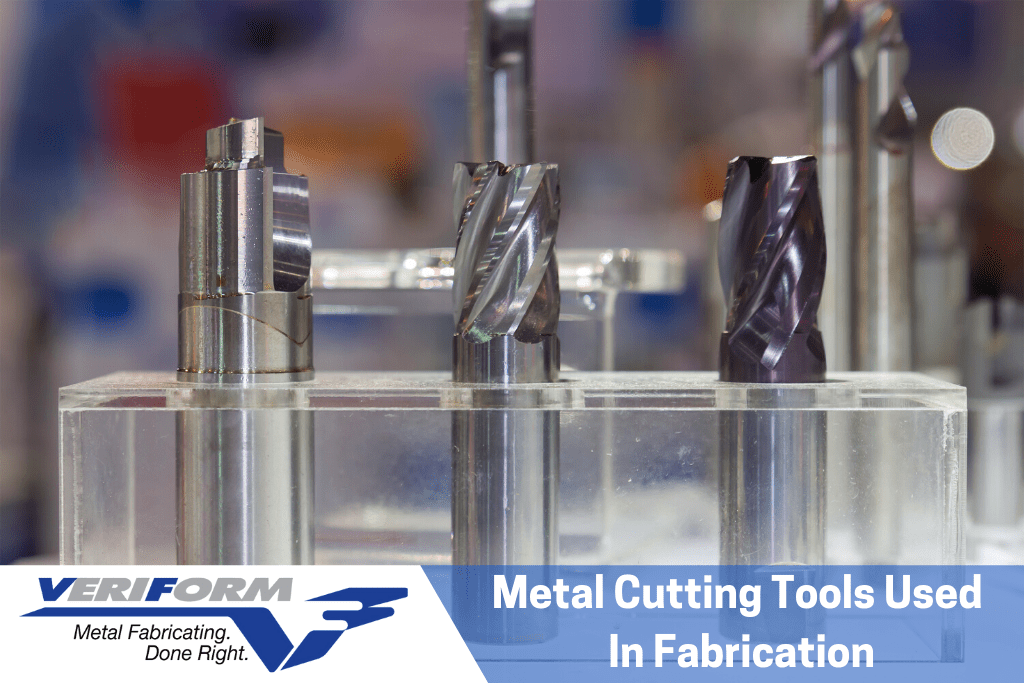
When you work in the fabrication industry, you’ll know that every metal fabrication company requires the use of many different metal cutting tools. These tools are used to create the desired effects in structures and designs by removing unwanted material from constructed pieces of metal. As a metal fabricator, an understanding of how these tools work and how they’re used is crucial in fabrication.
Each tool has its own advantages and disadvantages so it’s important to find tools that’ll meet your requirements. There are two types when it comes to different metal cutting tools and those include single-point tools and multi-point tools. Single-point tools are used to get rid of extra material through shaping, turning and other related processes with one cutting edge. Whereas multi-point tools are used during the grinding, drilling, and milling processes and often have teeth or multiple cutting edges. We’ll continue to identify different tools from both types.
Single Point Metal Cutting Tools
To start off, a single-point metal cutting tool is used to perform several operations. They can be made with a variety of materials including high carbon steel, ceramics, and diamonds to name a few. Some advantages of single-point tools are easy design and fabrication along with a more affordable price. However, because one blade is constantly working away at the material, wear and breakage is a more frequent occurrence. To continue, let’s discuss what some of the single point cutting tools are:
Turning Tools:
Turning tools are used to cut or finish the external diameter of your structure. They can also be used to produce cylindrical workpieces. There are many different types of turning tools such as woodturning tools, hollowing tools, bowl gouges and more. Different types are used for different purposes and materials due to their strength, durability and other specifications.
Shaping Tools:
Shaping tools do exactly what the name describes. They’re used to cut in curves, certain angles, and other kinds of shapes all thanks to a disc. The disc is responsible for the tool’s rotation which then allows the forward and backwards movement making it easier to shape your fabrication projects. It’s most commonly used on wood and metal.
Other examples of single point metal cutting tools include:
Planing tool
Slotting tool
Boring tool
Fly cutter tool
Multi-Point Metal Cutting Tools
A multi-point metal cutting tool contains multiple cutting edges that work together during a single operation. The number of edges can range from three to hundreds depending on the tool and what it’s used for. They’re known for their efficiency when it comes to removing excess material as multiple cuts are made simultaneously. The tools are known to run longer and be more wear-resistant as the heat generated gets distributed across each blade. Here is some more information about the different kinds of multi-point cutting tools.
Milling Cutters:
Milling cutter tools are ultimately used in milling machines to perform milling operations. It consists of multiple grooves that act as blades that rotate to scrape off material or reshapes a workpiece. They’re often made from hard, strong materials that can withstand significant amounts of stress without breakage.
Reamer Tool:
A reamer is a kind of rotary metal cutting tool that is designed to enlarge or widen the size of pre-existing holes with high degrees of precision that leave smooth finishes. Reamers are provided with long flutes or grooves that can be straight or spiral. The flutes also allow chips, cooling and lubricating fluid to pass through to reach the cutting edges. This helps with the cooling process making your tool last longer and decreases breakage.
Other kinds of multi-point tools are:
Grinding wheel
Drills
Broaches
Hobs
Knurling tools
Metal Fabrication Experts – VeriForm Inc.
Are you looking for an expert metal fabrication team to complete your metal projects? Then VeriForm Inc. is exactly what you’re searching for. Not only are they an award-winning metal fabrication company, but they’ll also get the job done right the first time. They specialize in parts fabrication, architectural fabrication, CNC machining and more all throughout Ontario. Whether you’re looking to build new structures or to revamp a previously made structure, VeriForm is here to help. They have a professionally skilled team, new high-tech equipment, and a commitment to getting the job done right. Contact VeriForm Inc. today to get a quote for any metal fabrication task you may have.
As a manufacturer, we have done very well by reducing our GHG emissions from 262 tonnes back in 2006 to as little as 60 tonnes per year in 2019 and then buying carbon offsets for the remaining emissions. In fact, we just received an award for 6 years of being carbon neutral.
At the same time, we have realized that we need to go to the next step, to broaden our focus beyond just GHG emissions and carbon footprint. Many of the best companies we deal with have pointed to becoming B Corp Certified because that certification takes into consideration greater areas of goodwill and socially positive results, not just profit generation. The B Corp website defines it extremely well by stating:
“The B Corp community works toward reduced inequality, lower levels of poverty, a healthier environment, stronger communities, and the creation of more high-quality jobs with dignity and purpose. By harnessing the power of business, B Corps use profits and growth as a means to a greater end: positive impact for their employees, communities, and the environment.”
We are especially excited about this new development as our past experience has shown us that driving down our GHG emissions out of a sense of altruism also increased our profits. So with this in mind, we have decided to end our ISO 50001 energy management system and put our focus on becoming B Corp certified. We strongly believe this will benefit our customers and our staff, plus the broader community. To learn more about the B Corp visit https://bcorporation.net/
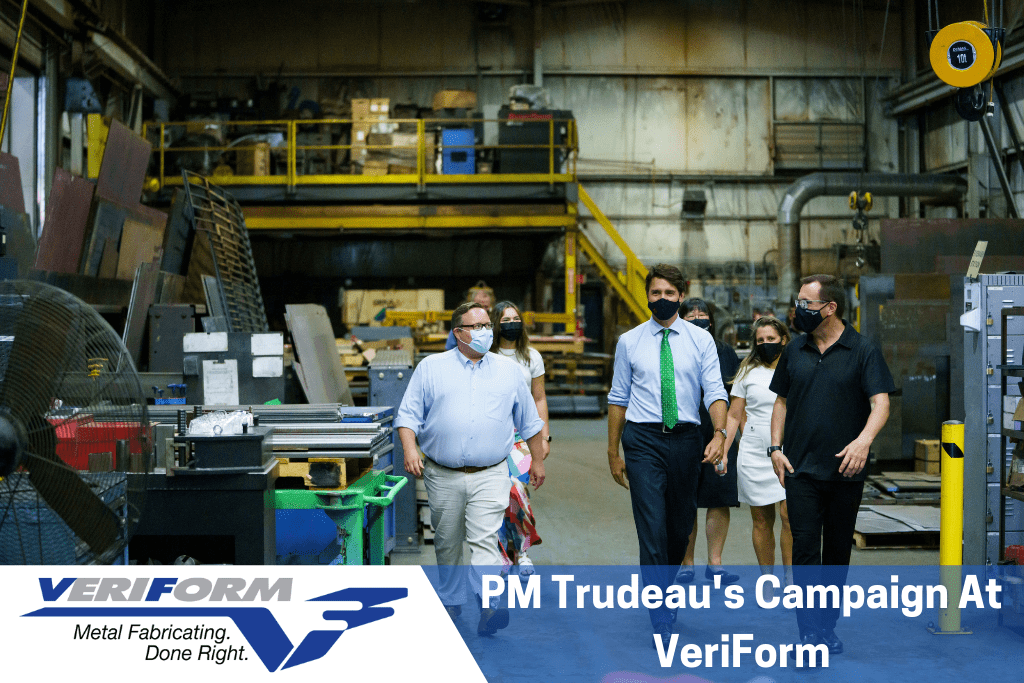
Prime Minister Justin Trudeau visits VeriForm for his campaign event on climate change in Cambridge, ON.
Last weekend, Prime Minister Justin Trudeau along with the Minister of Finance, Chrystia Freeland and the Liberal candidate, Bryan May hosted a campaign event at VeriForm Inc. to discuss the Liberal Party’s agenda on sustainability and climate change. This is a prevalent issue as the total greenhouse gas emissions of carbon dioxide equivalent in Canada have increased to 730 megatonnes within the year of 2019.
Their climate plan entails that oil and gas companies would be required to set a five-year plan to decrease their greenhouse gas emissions. This is an obligation that’ll eventually lead to the party’s goal of net zero emissions by 2050. Cars being sold in Canada would also be required to take a part in reaching this goal. The target is to cut back on 50% of emissions by 2030 and zero emissions by 2035. Upon re-election, this plan would also include funding $2 billion to ensure “green” jobs are created within the oil industry.
To see what the Liberal Party had to say during the campaign, click here.
What is Net Zero Emissions?
The term “Net Zero Emissions” has been mentioned quite often but what does it actually imply? Net zero emissions also referred to as carbon neutrality, can be defined by an economy that no longer produces greenhouse gases. It also indicates that the economy is able to offset emissions. Offsetting emissions means that emissions are still being produced but in lower quantities. However, as long as there is a method to counteract the emissions, you’re still considered to be at net zero. Being at net zero also includes reducing greenhouse gases and ridding emissions that have already reached the atmosphere.
There are many strategies businesses can use to reach net zero. Planting more trees to filter oxygen or taking initiatives in creating a greener work environment. A greener workspace could suggest using environmentally-friendly equipment, tools and technology. Another method that would be proactive to this cause would be transitioning from the usage of non-renewable to renewable energy. Switching from fossil fuel, coal and petroleum to solar, hydro, or wind to name a few. That being said, the point of net zero is to restore the state of the world prior to climate change. It’s an essential goal that is currently in the process of being met all across the globe.
Why VeriForm?
Now that we understand why reaching net zero is so important, how does this tie in with VeriForm Inc.? Simply due to the fact that VeriForm is one of the examples of businesses that have reached the net zero goal. The CEO of VeriForm, Paul Rak started his sustainability journey by cutting his company’s greenhouse gas emissions back in 2006. Soon after, he invested $46,000 in energy-efficient changes all throughout his company. With this investment, Paul installed efficient lighting, heating systems and more to reduce energy usage.
Although it seems like a large amount of money to invest, VeriForm’s return on investment was $90,000 from reduced energy bills alone. Last year back in 2020, VeriForm was able to reduce its greenhouse gas emissions by 75%. They only needed to offset 25% on emissions. This was also the year he won the Net Zero Award for demonstrating his success in maintaining net zero for one or more years. Even now, Paul Rak is taking steps in continuing his work to becoming a more sustainable metal fabrication company. It goes to show that with perseverance, and time any company can become green to reach that net zero goal towards a better future.
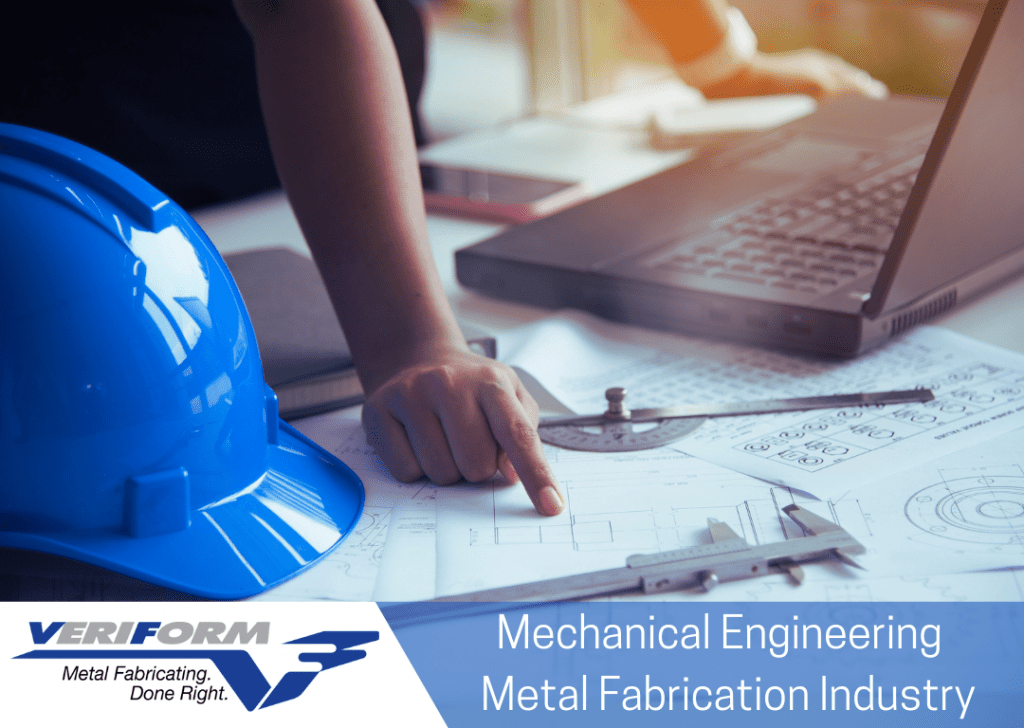
Nowadays, it’s easy to be amazed by the wonders of modern mechanical engineering. The sheer difference in design and capability is astounding if you look at tools and machines from 100 years ago compared to today. This is all thanks to the mechanical engineers as well as other brilliant minds who tirelessly toiled and studied the science behind how things work and how to make them work more efficiently.
The world of metal fabrication also owes a lot to mechanical engineers. Mechanical engineering is a core discipline within the industry, and it covers almost everything from planning, operations, to development. These modern technological wizards can make something out of nothing. But how important are mechanical engineers in the metal fabrication industry? Let’s continue to discuss their importance.
Mechanical Engineering in the Metal Fabrication Industry
Within every industry, there are key members that play a crucial role in ensuring everything functions correctly and smoothly – like a central cog in a watch. Mechanical engineers are the ones who play that role in the metal fabrication industry.
Mechanical engineering is ultimately one of the more diverse types of engineering. It is the branch of engineering that focuses on the design, production, the operation of machines and much more. In order to be a successful mechanical engineer, you need to study and understand engineering physics, mathematics and wrap everything up with materials science. This will allow you to design, analyze, manufacture, and maintain mechanical systems.
In metal fabrication, multiple mechanical engineers are needed within the team. They are in charge of taking an idea, creating a prototype, tweaking the prototype, and producing the finished product. Mechanical engineering can dictate the capabilities of a metal fabrication company. A metal fabrication company without a mechanical engineer is like a restaurant without a cook.
Mechanical Engineering within Other Industries
Due to the extensive scope of mechanical engineering, you can see mechanical engineers in various industries. Mechanical engineers are central to a lot of industries that rely heavily on machinery. While most mechanical engineers work in offices, some might need to visit worksites to do routine checks and/or regular maintenance work.
Other industries that require mechanical engineering include:
Architecture industry
Scientific research and development industry
Manufacturing industry
Computer and electronic product manufacturing
Aerospace industry
Automotive industry
Becoming a Mechanical Engineer in Ontario, Canada
The idea of being a central figure in any industry can be pretty tempting, but the journey to becoming a mechanical engineer in Ontario, Canada, is not easy. To become a mechanical engineer, you need a bachelor’s degree in mechanical engineering or mechanical engineering technologies. The difference between the two is that mechanical engineering programs focus on theory and application, while a mechanical engineering technology program dives into the practical application of the principles.
Aside from a bachelor’s degree, getting a master’s or doctorate can also help but isn’t necessary. However, a license provided by a provincial or territorial association of professional engineers is required for most work opportunities. It’d be a good idea to obtain one beforehand. Lastly, depending on the job requirements, you might need to get a professional license from a regulatory authority. If the license requirement is compulsory, you need to get certification first before you can work. However, if the requirement is voluntary, you can forego getting a license before starting work.
Metal Fabrication in Ontario, Canada
Although it takes a lot of time and hard work to become a mechanical engineer, the payoffs are worth it. The average base salary for a mechanical engineer in Canada starts off at $62,000. You’ll be able to find fulfilling work through a variety of industries. Are you a budding mechanical engineer who’s interested in knowing whether or not you are a good fit in the metal fabrication industry? Visit VeriForm today to browse through the services they have to offer. You’ll get a good idea of what they do and how you can play a part as a mechanical engineer.